
What Emissions Does a Natural Gas Fueled Generator Produce?
A natural gas generator is often chosen where a stable gas supply, predictable standby duty, or lower local particulate emissions than some liquid-fuel options are important. That does not mean it is emission-free. A natural gas fueled generator produces combustion gases at the exhaust, and the exact mix depends on engine design, fuel quality, load, ambient conditions, maintenance, and any emissions-control equipment.
From a system-selection engineer’s perspective, the useful question is not simply “Is a natural gas generator clean?” It is: which emissions matter at this site, how will the unit operate, and what controls or permits apply? This article separates local air pollutants from greenhouse gases so project teams can ask better questions before specification.
The main emissions from a natural gas generator
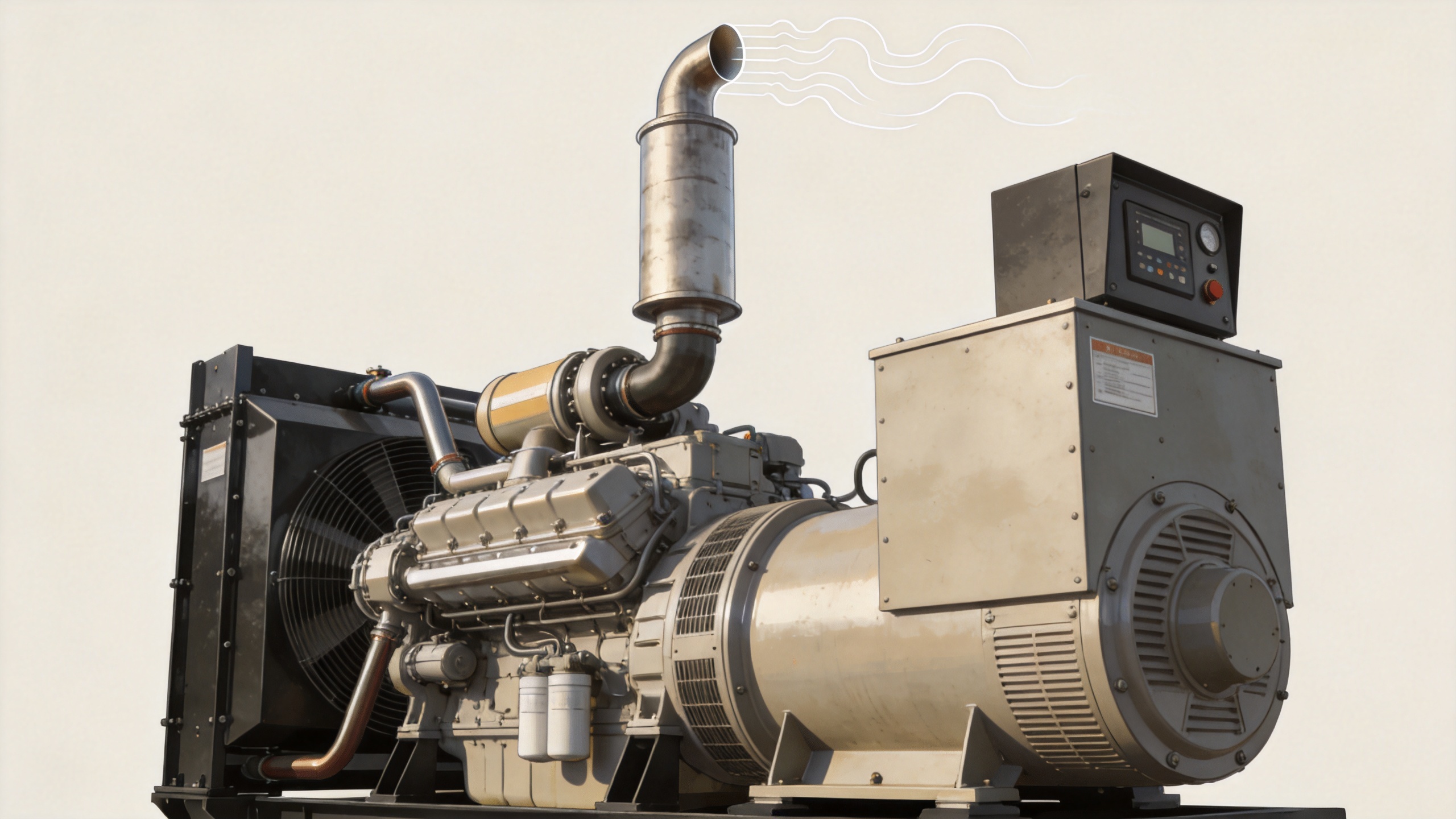
When methane-rich fuel burns in a natural gas generator, the principal exhaust components are water vapor, carbon dioxide, nitrogen, and excess oxygen. The emissions that usually need attention are carbon dioxide (CO2), nitrogen oxides (NOx), carbon monoxide (CO), unburned hydrocarbons or volatile organic compounds (VOCs), and small amounts of methane (CH4) and nitrous oxide (N2O). Sulfur dioxide (SO2) and particulate matter can also be present, but pipeline-quality natural gas generally contains little sulfur and produces relatively low filterable particulate matter compared with many heavier fuels.
- CO2: The largest direct greenhouse-gas emission by mass from normal combustion. It is not a local toxic pollutant at typical stack concentrations, but it is central to carbon accounting.
- NOx: A group of nitrogen oxides that can contribute to ozone and smog formation. It is often a primary permitting and control concern for stationary engines.
- CO: A sign that combustion is incomplete. It is an important safety and air-quality concern, especially in enclosed or poorly ventilated areas.
- VOCs and methane: Normally smaller exhaust constituents, but relevant to hydrocarbon and climate assessments.
- SO2 and PM: Usually low for clean natural gas, yet not automatically zero; fuel composition and site conditions still matter.
Carbon dioxide: lower does not mean zero
A natural gas fueled generator releases CO2 whenever it converts fuel energy into electricity. For context, the U.S. Energy Information Administration lists a natural-gas carbon-dioxide coefficient of about 116.65 lb CO2 per million Btu of fuel input. This is a fuel-input reference, not a guarantee for a particular generator. Actual CO2 per kilowatt-hour changes with engine efficiency, electrical load, start-stop behavior, parasitic loads, and maintenance condition.
That distinction is easy to overlook. A lightly loaded natural gas generator may consume fuel less efficiently than a unit operating near its intended duty point, so emissions per delivered kWh can rise. If a project tracks carbon performance, measure or estimate fuel use over real operating hours rather than relying on a single generic comparison.
Why NOx and carbon monoxide change with operating conditions
NOx is strongly influenced by combustion temperature, oxygen availability, and the time gases remain in the high-temperature zone. In practical terms, a natural gas generator’s tuning, air-fuel ratio, load profile, and control system can change NOx results substantially. Lean-burn and rich-burn engine approaches may use different control strategies, so the applicable limits and aftertreatment options need an engine-specific review.
CO tends to increase when combustion is incomplete. Causes can include poor air-fuel mixing, unsuitable calibration, transient loading, ignition problems, or inadequate maintenance. It is tempting to focus only on the nameplate rating, but a more accurate assessment starts with the expected load curve and operating schedule. If fuel availability and maintenance arrangements are stable, that assessment becomes much more useful.
How a natural gas fueled generator compares with other fuel paths
Natural gas is often selected because it can reduce certain local emissions relative to heavier liquid fuels, particularly sulfur oxides and visible soot-related particulate emissions when the gas supply is clean. However, a natural gas generator can still produce NOx, CO, VOCs, and CO2. It should therefore be evaluated as a controlled combustion asset, not described as a zero-emission power source.
For a fair comparison, use a common boundary: fuel consumed, delivered electricity, operating hours, location, and maintenance plan. Also separate exhaust emissions from upstream methane leakage, which occurs outside the generator stack but may matter in broader greenhouse-gas accounting. The appropriate comparison depends on site conditions, resilience needs, grid reliability, and any renewable or storage assets in the wider power system.
Practical ways to manage emissions
- Define the duty cycle first. Identify prime, standby, peak-shaving, or emergency operation and map likely load steps.
- Request application-specific emissions data. Ask the supplier for engine-family data at the intended rating, fuel specification, and control configuration rather than assuming one number fits every installation.
- Check local rules early. Permitting thresholds, stack testing, monitoring, and emergency-generator exemptions differ by jurisdiction.
- Specify controls with the engine. Combustion tuning, oxidation catalysts, three-way catalysts, selective catalytic reduction, and other measures are not interchangeable; their suitability depends on the engine and operating window.
- Maintain fuel and air systems. Scheduled checks of ignition, valves, filters, sensors, and exhaust equipment help preserve both reliability and emissions performance.
- Plan for ventilation and CO safety. A natural gas fueled generator belongs outdoors or in a properly engineered, ventilated installation with appropriate detection and safety practices—not in an occupied enclosed space.
A decision checklist for project teams
Before selecting a natural gas generator, document the fuel source and pressure range, annual operating hours, expected load profile, applicable emissions limits, required controls, commissioning tests, and maintenance responsibilities. Then confirm how those inputs fit the overall energy plan. Jiangsu Keya New Energy works across natural gas, biogas, hydrogen, methanol, LPG, solar, wind, and energy-storage directions, so the most useful conversation is usually about the complete site energy boundary rather than a single equipment label.
The takeaway is straightforward: a natural gas generator produces CO2, NOx, CO, small quantities of hydrocarbons and other combustion byproducts, plus typically low SO2 and particulate matter when supplied with clean gas. The emissions profile is manageable only when the engine, controls, load, installation, and compliance requirements are considered together.
Frequently asked questions
Does a natural gas generator produce carbon monoxide?
Yes. A natural gas generator can produce carbon monoxide, particularly when combustion is incomplete. Use proper outdoor placement or engineered ventilation, and follow local safety requirements.
Is a natural gas fueled generator carbon neutral?
No. A natural gas fueled generator emits carbon dioxide during combustion. Its carbon impact should be evaluated using actual fuel consumption, operating efficiency, and the chosen accounting boundary.
What is usually the key regulated pollutant?
For many stationary gas-engine applications, NOx is a key permitting concern, but the applicable rule depends on location, engine size, use category, and local authority requirements.
 Hot News