
What Infrastructure Supports a Commercial Hydrogen Generator?
A commercial hydrogen generator is not a drop-in replacement for a diesel set. It is a site power system that depends on fuel handling, controls, electrical protection, and operating procedures working together. For facility owners, the most reliable approach is to define the hydrogen generator boundary early: where hydrogen arrives or is made, how it is conditioned, where power is delivered, and who owns each safety interface.
From an engineering and project-planning perspective, infrastructure should be sized around the duty profile rather than the nameplate alone. A hydrogen generator serving short peak-shaving events has different storage, heat-rejection, and grid-interconnection needs from a hydrogen generator providing extended backup power. The checklist below helps procurement and engineering teams turn that distinction into an implementable project scope.
Start with the duty profile and system boundary
Before selecting equipment, document the load in kilowatts, starting current, runtime, annual operating hours, and whether the hydrogen generator will run islanded, in parallel with the grid, or alongside batteries and renewable generation. Identify critical and noncritical loads so that the hydrogen generator and switchgear are not oversized simply to cover every circuit.
Then draw a one-line diagram from hydrogen supply to the final load. It should include the commercial hydrogen generator, fuel storage or production equipment, pressure-control stages, emergency shutoffs, power-conditioning equipment, transfer or paralleling gear, grounding, and remote monitoring. This simple boundary drawing reveals interfaces that are often missed in early budgets.
Hydrogen supply, storage, and conditioning
A hydrogen generator needs a dependable fuel source. Depending on local logistics and operating hours, that may be delivered compressed hydrogen, on-site electrolysis, pipeline supply, or another approved supply arrangement. The fuel strategy needs a consumption model that accounts for normal operation, contingency runtime, delivery lead time, and the amount of usable gas left at the minimum permitted pressure.
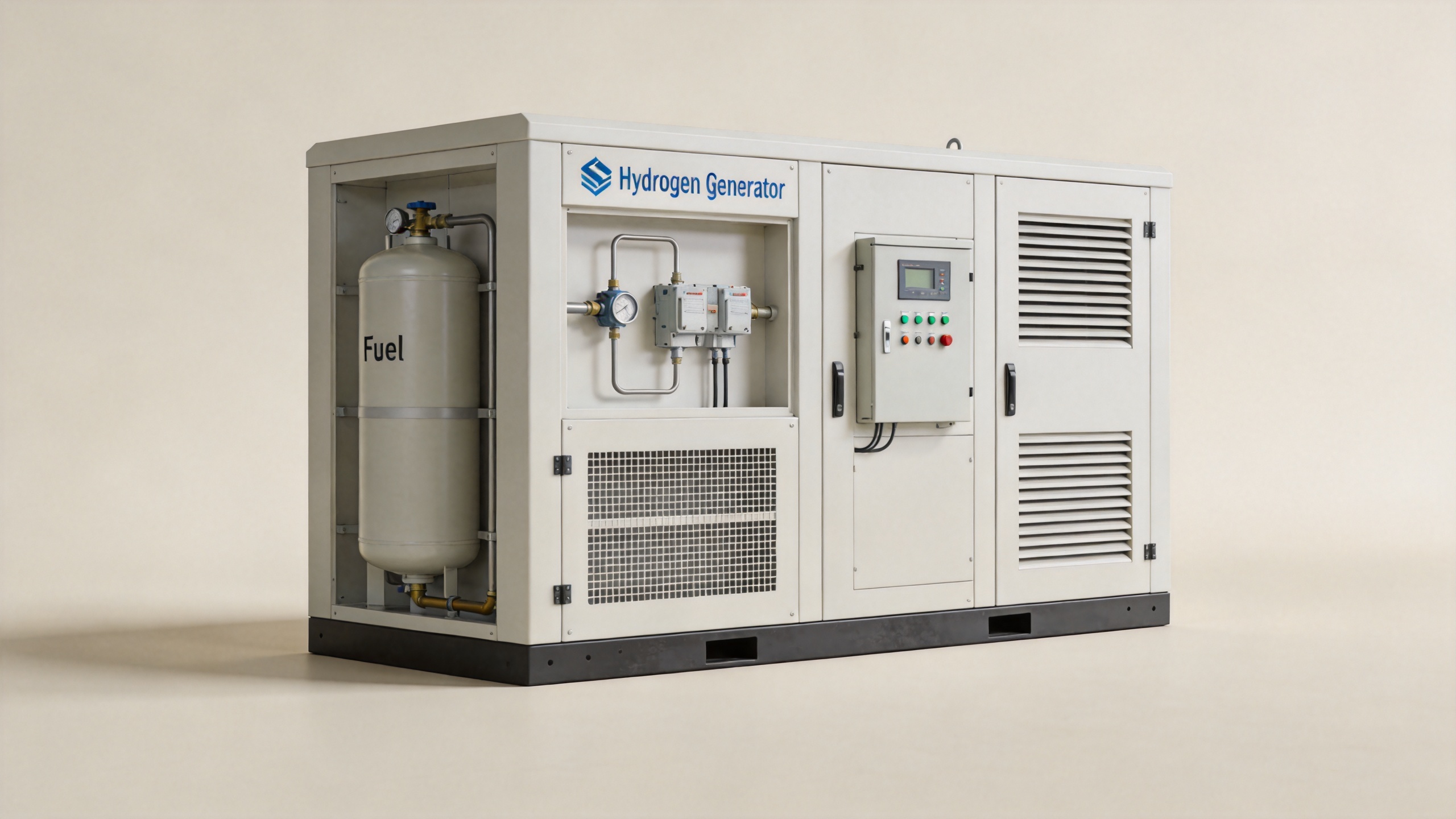
Storage is more than a bank of cylinders. The commercial hydrogen generator installation needs an approved storage location, vehicle access if deliveries are planned, restraints and protection from impact, clear operating space, and a controlled route for piping. Pressure regulation, filtration where required by the equipment supplier, isolation valves, venting provisions, and appropriately rated fittings should be specified as a single fuel train. Do not assume a storage package includes every component between the delivery connection and the hydrogen generator inlet.
Fuel quality and pressure stability also deserve a written acceptance criterion. Ask the generator supplier for inlet pressure range, purity limits, allowable transients, and shutdown behavior. This prevents a common mismatch: storage is technically adequate, but the hydrogen generator trips when demand changes or when pressure falls near the end of a run.
Site layout, ventilation, and gas detection
Hydrogen’s physical behavior drives layout decisions. Because it is very light, released gas can collect at high points when a structure does not provide a clear path to a safe location. A commercial hydrogen generator room or enclosure should therefore be designed with the relevant authority having jurisdiction, local fire requirements, and the equipment manufacturer’s installation instructions in mind.
Typical planning topics include separation from occupied areas and ignition sources, access for inspection and emergency response, mechanical or natural ventilation, high-point gas detection, and automatic actions when a detector alarms. Those actions may include closing fuel valves, stopping the hydrogen generator, starting ventilation, annunciating locally, and reporting to a building-management or supervisory system. Applicable frameworks can include NFPA 2 and local regulations, but the final design must be reviewed for the specific jurisdiction and fuel-storage arrangement.
Use a hazard review to define the cause-and-effect matrix. It should state which sensor or condition triggers each response, how the response is tested, and how a safe restart is authorized. This gives operators a usable process rather than a collection of disconnected safety devices.
Electrical integration and power quality
The electrical side of a commercial hydrogen generator deserves the same rigor as the fuel side. Specify the voltage, frequency, fault contribution, neutral arrangement, protective relays, cable routing, and breaker ratings at the point of connection. For standby duty, determine whether an automatic transfer switch provides the intended sequence. For grid-parallel duty, the hydrogen generator may require synchronization, anti-islanding protection, metering, utility approval, and a defined export limit.
Where a hydrogen generator works with photovoltaics, wind, or battery storage, establish a control hierarchy. Decide which asset follows load, which maintains frequency or voltage in island mode, and how the system recovers after a fuel interruption. A short controls workshop with the generator, storage, inverter, and switchgear stakeholders can avoid late software changes and ambiguous responsibility.
Also plan for auxiliary loads: compressors, cooling equipment, ventilation fans, controls, communications, and any water-treatment or electrolyzer loads. These loads affect both net site power and the electrical distribution design. A commercial hydrogen generator project should report net deliverable power, not only generator nameplate output.
Cooling, drainage, and utility connections
Every hydrogen generator has thermal and maintenance needs. Confirm whether the commercial hydrogen generator uses an integrated radiator, remote heat exchanger, liquid loop, air-cooled arrangement, or a site-provided cooling circuit. Reserve service clearances and a route for ventilation air or heat rejection. If the fuel source is on-site electrolysis, include water quality, water supply, drainage, and treatment requirements in the scope instead of leaving them to a later package.
Outdoor installations need civil design as well: equipment pads, drainage, bollards where appropriate, cable trenches, earthing, lighting, weather protection, and access for replacement components. The civil scope should protect safe access without blocking ventilation paths or emergency isolation points.
Controls, communications, and cybersecurity
A commercial hydrogen generator should provide enough data for operators to recognize a developing problem before it becomes an outage. At a minimum, agree on run status, fuel pressure, alarms, emergency-stop state, electrical output, maintenance counters, and communications health. Define which signals appear at the local panel, which go to the building-management system, and which may be viewed remotely.
Remote access should be segmented and controlled rather than treated as a convenience feature. Assign user roles, preserve alarm and event logs, define patch responsibility, and document an offline operating procedure. For critical facilities, test communication loss separately from a generator fault so the team knows which alarms remain visible.
Commissioning, training, and lifecycle readiness
The final infrastructure element is the operating system around the equipment. Commission the commercial hydrogen generator with witnessed functional tests: normal start and stop, simulated gas detection, emergency shutdown, transfer or parallel sequences, loss of communication, and restoration after an alarm. Record initial settings and as-built drawings.
Training should cover routine inspection, fuel-delivery coordination, alarm response, permit-to-work controls, and escalation contacts. Build a maintenance plan that includes safety devices, regulators, detectors, ventilation equipment, electrical protection, and the hydrogen generator itself. A supplier with experience across hydrogen, gas generation, and integrated new-energy systems can help align these interfaces, but the site owner should retain a clear acceptance checklist.
A practical infrastructure checklist
- Validated load profile, runtime target, and operating mode for the hydrogen generator.
- Approved hydrogen supply, storage capacity, delivery access, pressure regulation, and isolation plan.
- Site layout with ventilation, gas detection, emergency shutdown, access, and authority review.
- Electrical one-line diagram, protection study, transfer or grid-parallel controls, and auxiliary-load allowance.
- Cooling, civil works, drainage, utility connections, communications, and cybersecurity responsibilities.
- Commissioning scripts, operator training, maintenance records, and emergency-response coordination.
When these elements are engineered as one package, a commercial hydrogen generator becomes a predictable power asset rather than an isolated piece of equipment. Start with the site duty profile, verify local requirements early, and make every fuel, electrical, and control interface visible in the project scope.
 Hot News