
How Safe Are LPG Electric Generators Indoors?
Short answer: an LPG gas generator should not run indoors. Liquid petroleum gas can be a practical fuel for standby and mobile power, but a combustion generator still produces exhaust gases. In a home, garage, basement, workshop, shed, vehicle bay, or any partly enclosed space, carbon monoxide (CO) can build up quickly. Opening a door or window is not an adequate control.
The key decision comes before the engine starts: define the space boundary, identify openings and air paths, and plan power delivery from outdoors. This article explains why an lpg electric generator does not become indoor-safe merely because it uses LPG, what to do instead, and when to ask a qualified installer or local authority for site-specific guidance.
Why an LPG gas generator is unsafe indoors
An LPG gas generator burns fuel in an engine to make electricity. Combustion creates exhaust, including carbon monoxide. CO has no color or smell, so people cannot rely on odor as a warning. The U.S. Consumer Product Safety Commission’s portable-generator guidance states that generators must never be operated inside a home or garage, even with doors and windows open.
The fuel choice changes some practical considerations, such as cylinder connection and fuel availability, but it does not eliminate exhaust. A portable lpg electric generator has the same fundamental indoor hazard as other engine-driven portable generators: exhaust can enter occupied areas, move through doors, windows, vents, or attached spaces, and expose people while they sleep or work.
Common locations that are still “indoors”
For generator safety, “indoors” includes more than a finished room. Do not operate an LPG gas generator in any enclosed or partly enclosed location, including:
- Attached or detached garages, even with the main door raised
- Basements, crawlspaces, utility rooms, and storage rooms
- Sheds, tents, greenhouses, workshops, or container-like structures
- Porches, balconies, carports, and alcoves where walls or a roof trap exhaust
- Vehicles, RV bays, boats, or loading areas without a purpose-designed, code-compliant installation
A covered location may feel outdoors, yet it can recirculate exhaust or direct it toward openings. If a space is close enough to protect the generator from weather, it may also be close enough to hold or funnel exhaust.
Safe placement: move the generator outside and away from openings
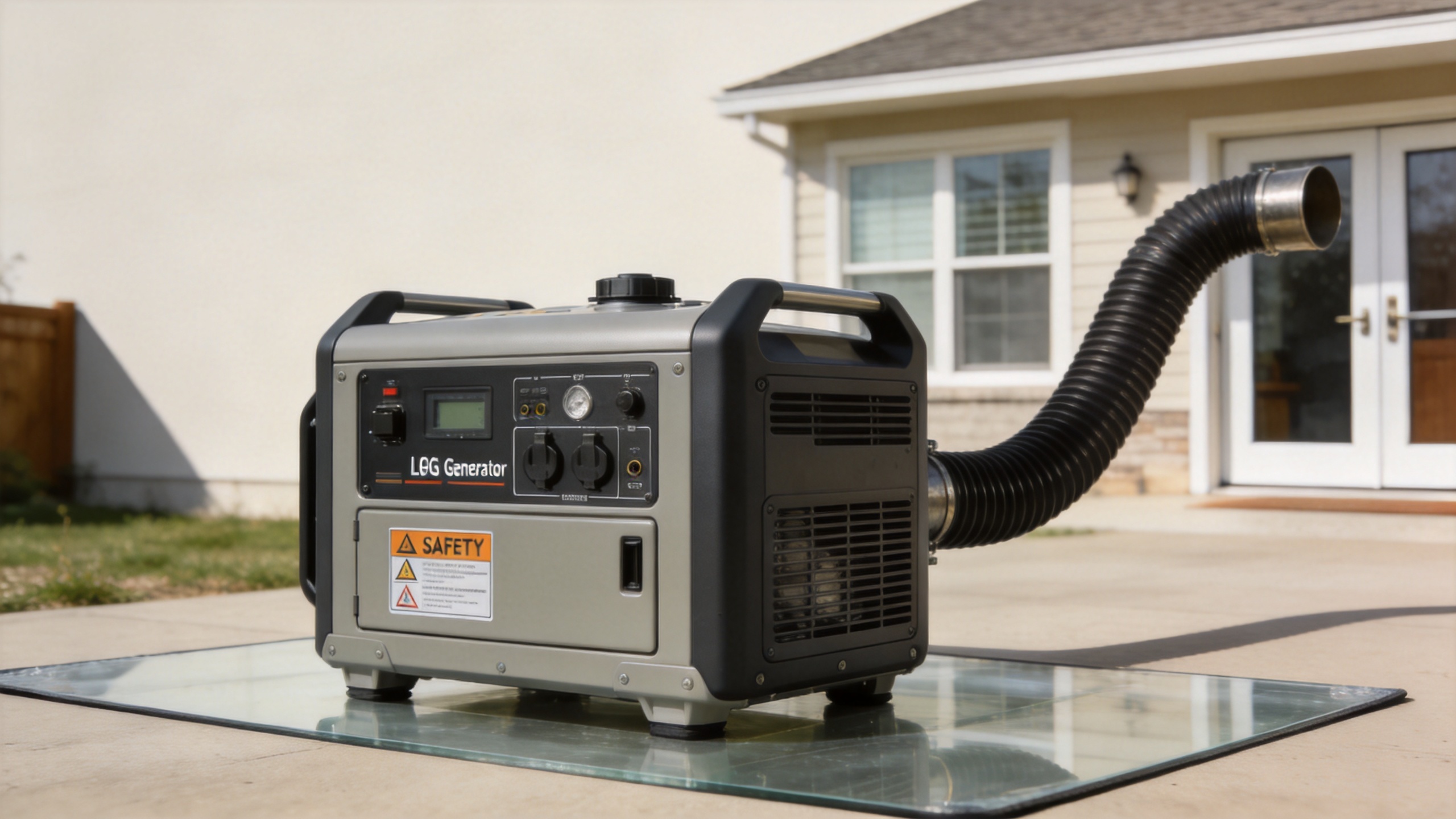
Set the LPG gas generator outdoors on a stable, dry surface where its exhaust cannot flow toward occupied space. Texas generator-safety guidance uses a minimum distance of 20 feet from doors, windows, and vents as a practical baseline. Use that distance as a starting point, then check the product manual, local requirements, wind conditions, and the specific site.
Point the exhaust away from buildings and avoid low spots, narrow passages, or walls that can reflect fumes. Keep the generator where rainwater, loose debris, vehicle traffic, and unauthorized access are controlled. Use outdoor-rated power distribution equipment that matches the load; do not route improvised cords through a window or a doorway that cannot close safely.
LPG cylinders add a separate fire and handling risk
Exhaust is the immediate reason an lpg electric generator must stay outside, but LPG handling needs its own plan. LPG is flammable, and a release can collect in low areas because the vapor is heavier than air. Keep cylinders upright, protected from impact and heat, and handled according to the cylinder supplier, generator manufacturer, and local fire-code requirements.
Before starting, inspect the hose, regulator, connectors, and cylinder valve for damage or contamination. If there is a suspected leak, do not start the engine, operate switches, or introduce an ignition source. Close the valve if it is safe to do so, move people away, and follow the emergency procedure supplied for the equipment and fuel system. Never treat a garage or basement as a convenient place to store or connect a working cylinder.
A practical pre-start checklist
- Choose the location: outdoors, clear of openings, with exhaust directed away from people and buildings.
- Read the manual: confirm the approved LPG connection, ventilation, grounding, load, and weather instructions for that specific model.
- Inspect the fuel path: check the cylinder, hose, regulator, fittings, and valve before every use.
- Protect the building: test CO alarms, especially outside sleeping areas and on each level of a home.
- Connect loads correctly: use properly rated cords or a transfer arrangement installed by a qualified professional. Never backfeed a building through a receptacle.
- Plan supervision: keep the generator accessible from outside and shut it down before refueling, reconnecting cylinders, or performing service.
What to do if a CO alarm sounds or symptoms appear
Headache, dizziness, weakness, nausea, vomiting, sleepiness, and confusion can be signs of carbon monoxide exposure. Do not investigate an alarm by staying inside. Get everyone to fresh air immediately, call emergency services or seek medical guidance as appropriate, and do not re-enter until responders say it is safe. Turn off the LPG gas generator only if you can do so without entering a hazardous space.
When you need indoor power
If the real requirement is power inside a building, keep the engine outdoors and bring electricity in through a correctly designed connection. For quiet, zero-exhaust indoor use, consider a battery power station or a properly designed energy-storage system sized for the actual load and runtime. Jiangsu Keya New Energy Co., Ltd. works across LPG generation and renewable-energy solution directions; a site-specific discussion should separate the outdoor generation system from the indoor load, wiring, and storage requirements.
For permanent standby applications, use a qualified installer to assess fuel supply, electrical transfer equipment, exhaust location, clearances, permits, and applicable codes. A fixed installation is not a reason to bypass ventilation or safety requirements.
The bottom line
An LPG gas generator is not safe to operate indoors. LPG may suit a particular fuel strategy, but it does not remove carbon-monoxide exhaust or fuel-handling hazards. Put the generator outdoors, keep it away from openings, use working CO alarms, and use properly designed electrical connections. If outdoor placement is impossible, choose a non-combustion indoor power option rather than trying to ventilate an engine-driven generator indoors.
 Hot News